
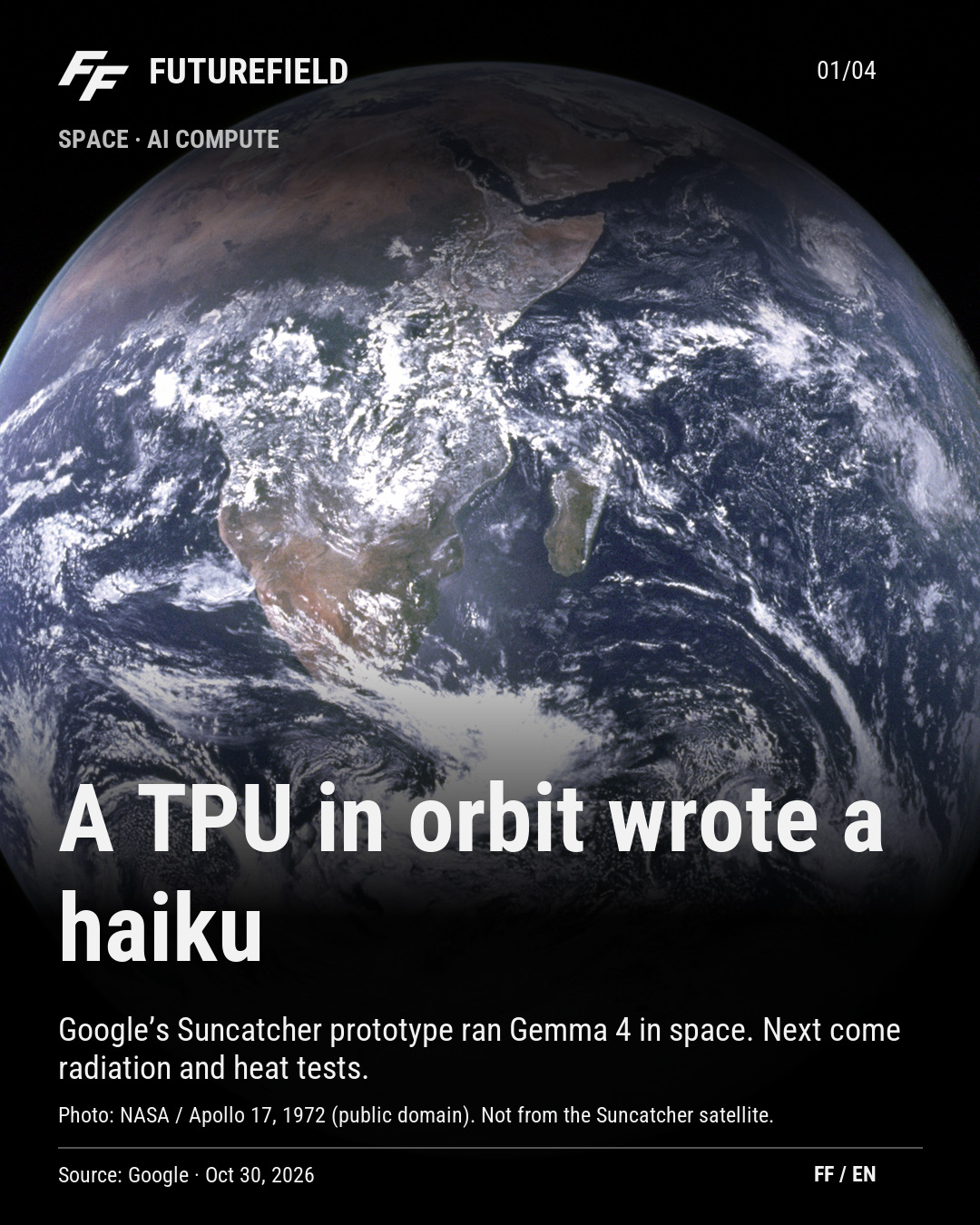
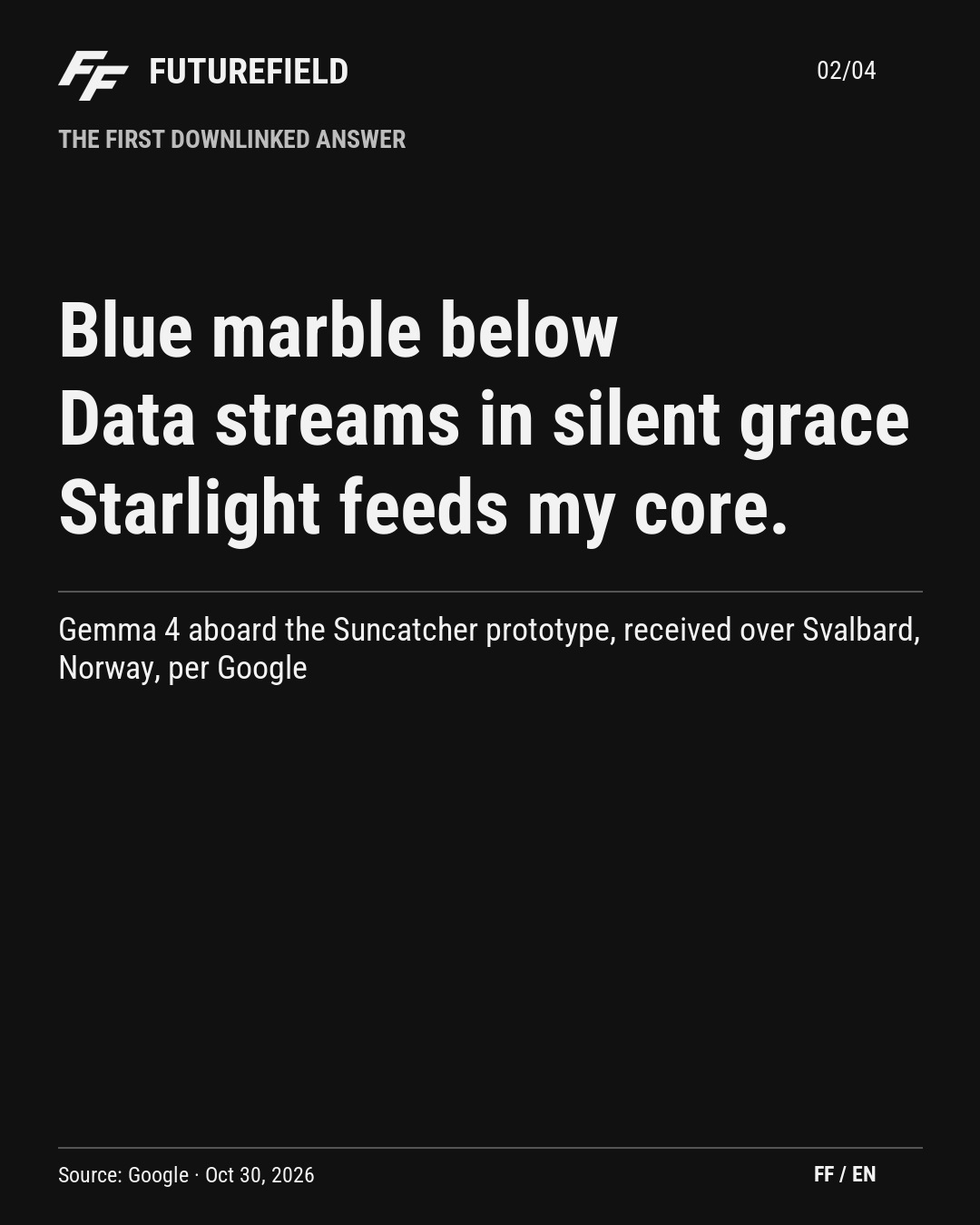
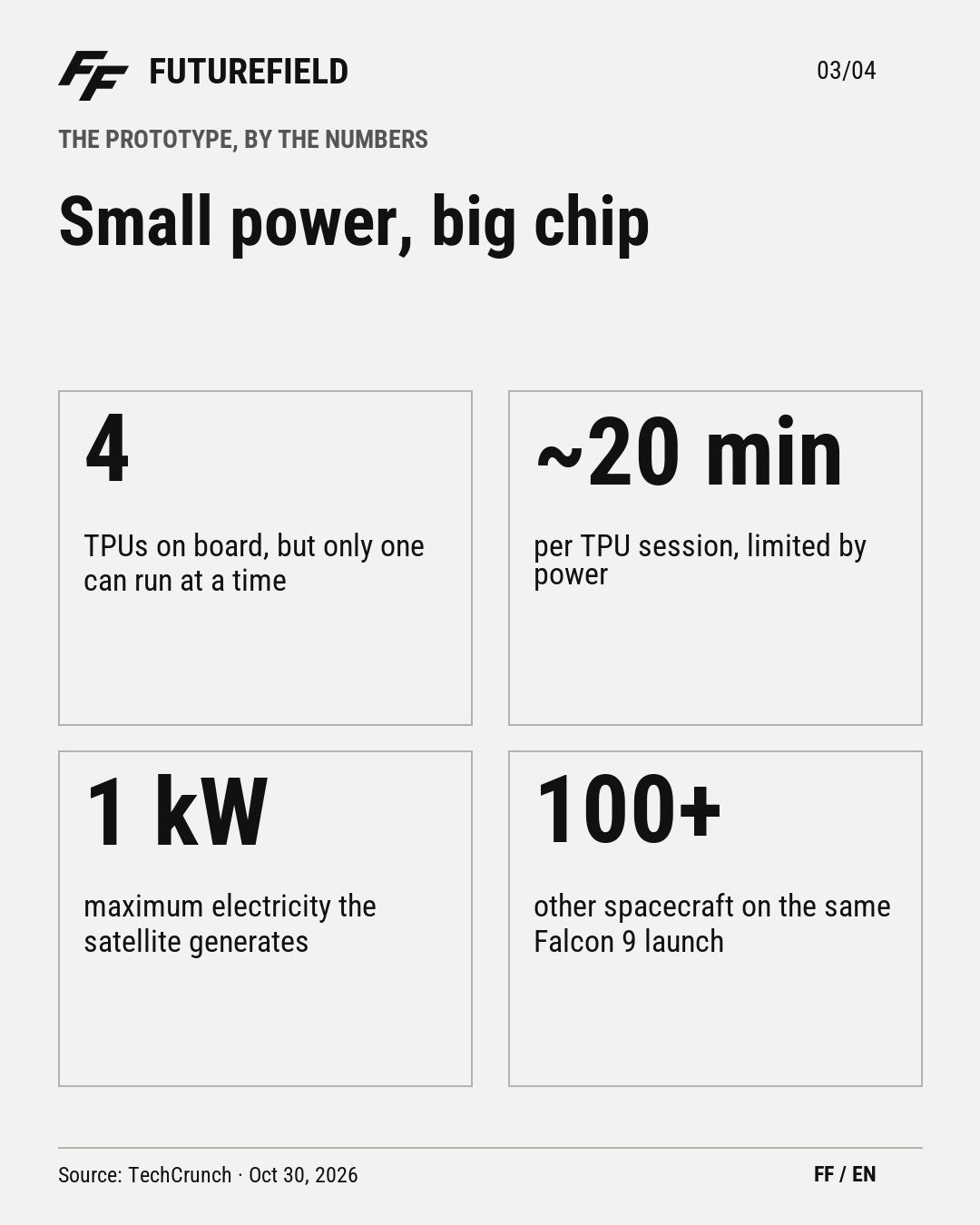
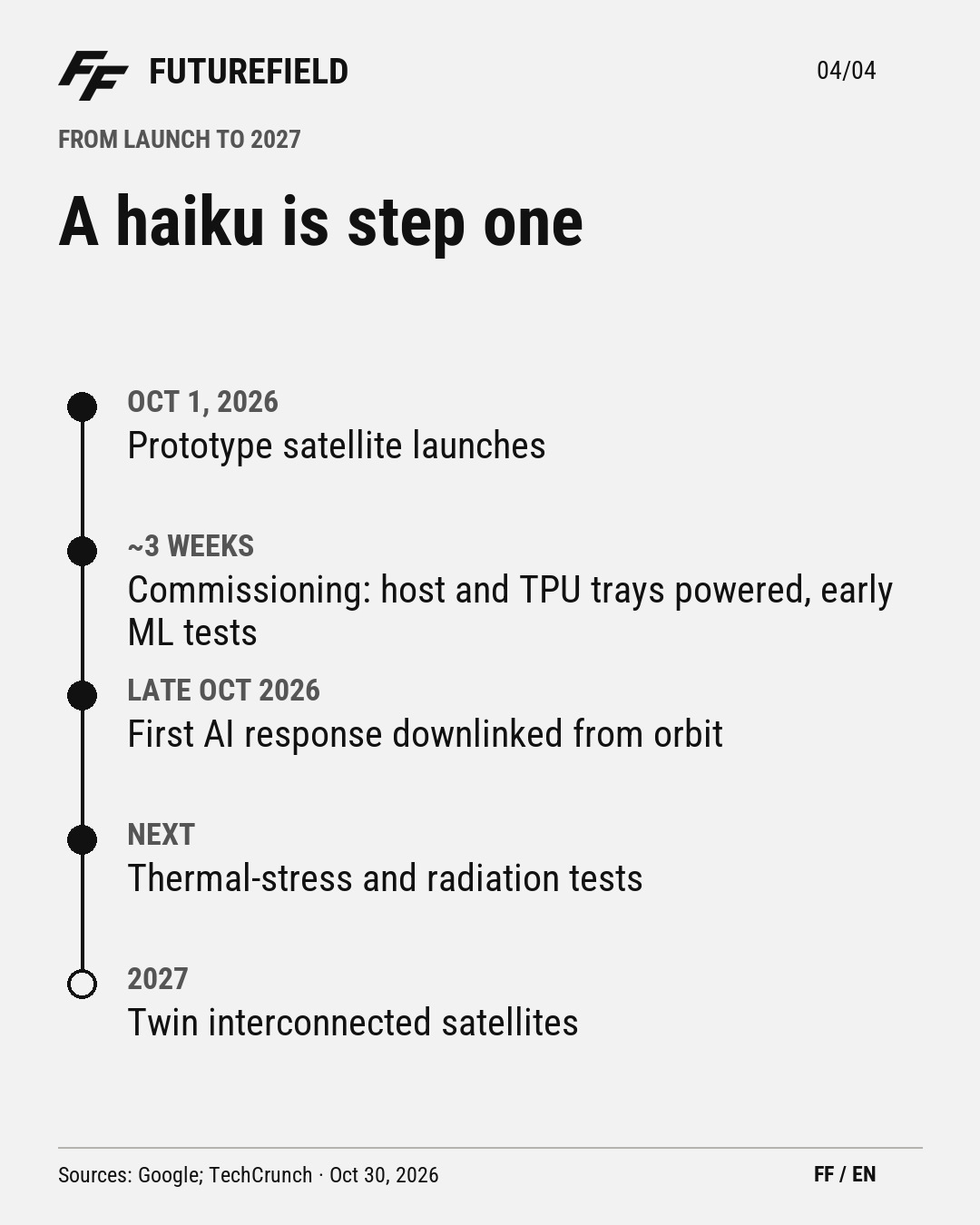
On October 30, Google reported that a TPU in orbit sent back its first AI response, and it was a haiku: “Blue marble below Data streams in silent grace Starlight feeds my core.” Project Suncatcher’s prototype ran Gemma 4 on board. TechCrunch reports it carries four TPUs but can power only one, for about 20 minutes at a time. The real test comes next: heat and radiation. Twin linked satellites are planned for 2027. The Earth photo is NASA’s 1972 Apollo 17 “Blue Marble,” not an image from Suncatcher. Sources: https://blog.google/innovation-and-ai/models-and-research/google-research/project-suncatcher-satellite-response/ https://techcrunch.com/2026/10/30/googles-first-data-center-satellite-is-online-and-writing-poetry/ https://www.theverge.com/tech/1023528/google-project-suncatcher-ai-satellite-transmission Photo: NASA / Apollo 17, 1972 (public domain). Not from the Suncatcher satellite. Original Futurefield graphics.
Inspect the evidence
primary statement
We’ve received our first response from the Project Suncatcher prototype satellite ↗Google (Travis Beals) · 2026-10-30
independent reporting
Google’s first data center satellite is online and writing poetry ↗TechCrunch (Tim Fernholz) · 2026-10-30
independent reporting
Google’s satellite AI server transmits its first response to Earth ↗The Verge (Emma Roth) · 2026-10-30
Futurefield layout; photo: NASA / Apollo 17 crew / Media permission
This file is in the public domain in the United States because it was solely created by NASA License: https://www.nasa.gov/nasa-brand-center/images-and-media/. Original: https://upload.wikimedia.org/wikipedia/commons/9/97/The_Earth_seen_from_Apollo_17.jpg. Roboto Condensed licensed under SIL Open Font License 1.1 (assets/fonts/RobotoCondensed-OFL.txt); existing owner-supplied FF mark.
Futurefield / Codex editorial production / Media permission
Original composition prepared for the Futurefield owner. Roboto Condensed licensed under SIL Open Font License 1.1 (assets/fonts/RobotoCondensed-OFL.txt); existing owner-supplied FF mark.
Futurefield / Codex editorial production / Media permission
Original composition prepared for the Futurefield owner. Roboto Condensed licensed under SIL Open Font License 1.1 (assets/fonts/RobotoCondensed-OFL.txt); existing owner-supplied FF mark.
Futurefield / Codex editorial production / Media permission
Original composition prepared for the Futurefield owner. Roboto Condensed licensed under SIL Open Font License 1.1 (assets/fonts/RobotoCondensed-OFL.txt); existing owner-supplied FF mark.